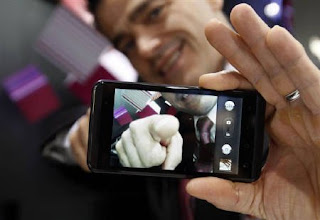
South Korea's LG Electronics hasn't been so smart with its smartphone business. Its mobile phone division has suffered five consecutive quarterly losses, cutthroat competition is pressuring it to overhaul the business and its shares have plummeted.
The money-losing phone unit has also been a major value destroyer for LG shareholders. LG's market value is only $7.5 billion, roughly one-third that of global rivals HTC Corp and Nokia, even though it also has sizeable TV and home appliances divisions.
LG's handset division is the company's biggest capital sinkhole and the shares have more than halved this year, making it the worst performer even when compared to HTC and Nokia.
LG says it is committed to its phone unit and is racking up successes, but investors aren't really listening.
"Selling the loss-making business is probably what investors want," said Harrison Cho, an analyst at KB Investment & Securities. "But even with that option, LG wouldn't get much from the sale. They should have sold it long ago before the overall landscape got tougher."
"They simply missed the boat," said Cho.
Setting up ventures with the likes of Philips and Nortel to share risks is what LG has done in the past in flat-screens and telecom gear. But analysts say there may not be many potential partners keen to team up with the loss-making mobile phone business.
The changing of the guard at Apple Inc could offer opportunities for rivals to chip away at the technology powerhouses's strongholds in some sectors, but on a standalone basis, LG is limited by its scale of operations in smartphones.
TARGETS CUT
The world's No.3 mobile phone maker has already cut this year's smartphone sales target by 20 percent to 24 million units and has given no outlook for when the business will turn profitable.
LG's Android-based smartphones are marketed under the Optimus brand and sales of such models as Optimus 2X and Optimus 3D have been solid, although nothing like the Galaxy and iPhone.
Koo Bon-joon, a member of LG's founding family, took over as CEO of the group's flagship firm in October and is cutting the portion of unprofitable feature phones and shifting focus to high-margin smartphones.
But the rapidly changing industry landscape has more bad news in store for LG.
Nokia has dumped its mobile platform and tied up with Microsoft to survive, while Motorola Mobility is selling itself to Google to become a handset manufacturer for the search giant.
"What LG can do at this point is keep doing what it can do best; keep upgrading its hardware offering, differentiate them and then diversify away from Android to Microsoft's Windows phones," said Jung Kyun-sik, a fund manager at Eugene Asset Management in Seoul.
LG is among StarMine's weakest companies for earnings quality versus its peers, with a percentile ranking of 8 out of 100. By comparison, Apple ranked 77.
Even a bolt-on acquisition, which many companies utilise to quickly expand, appears a difficult choice for LG to make.
"Buying a rival with either deep patent pools or research staff is another option to quickly boost its growth. But LG's not got much cash reserve to fund such deals," said S.J. Lee, a fund manager at Midas Asset Management, which holds LG shares.
LG had cash and cash equivalents of 2.2 trillion won ($2 billion) as of end-June and some 21 trillion in total debt.
WHAT'S IT WORTH?
LG is the world's No.6 smartphone maker and its market share, virtually negligible year ago, rose to 5.6 percent in the second quarter, ahead of Motorola and Sony Ericsson, following the long-awaited launch of its Optimus range.
Mobile phone sales totalled 3.2 trillion won ($3 billion), or roughly one-fifth of the group's total sales, in the second quarter.
"We sold off LG stock a couple of months ago due to its poor handset business prospects and don't have any plan to add it back any time soon," said a fund manager at HI Asset Management, who declined to be named because he was not authorised to speak to the media.
Valuing the unprofitable business is tough and how much potential buyers might be willing to pay for LG's sharply weakened brand value will decide much of the upside, analysts said.
Many analysts have forecast the business to turn profitable next year, but confidence levels have waned after the consecutive string of quarterly losses.
The dire business outlook had already pushed LG shares below their book value to a record-low multiple of 0.9 times its book value, much cheaper than Research In Motion's 1.6 times, Nokia's 1.1 and HTC's 8.2.
That's a huge discount for a company that is also a global brand in television and home appliances.
DILEMMA
Selling the phone business will be hard to swallow for the family-owned LG Group, which has invested heavily in phones to resuscitate the business and grow it as a core profit pillar.
LG reiterated its commitment to the unit on Friday.
"Our efforts this year have been successful despite the gloomy economic outlook in many parts of the world and we are confident that the handsets we have in the pipeline for 2012 will prove to be even more successful," the company said in a statement in response to queries from Reuters.
Koo, the CEO, has replaced the heads of the struggling phone and TV divisions and added research staff.
Reviving the business is crucial because its television business is also struggling with a razor-thin profit margin, leaving home appliances as a major cash generator for now.
"Hiving off the handset business can be an option, but the dilemma is nothing will be left at LG without handsets," said the HI Asset fund manager.
Being marginalised to a pure whitebox maker, a business that often suffers from thin margins, is something that many global technology firms are trying to avoid. That fate would also deny LG access to the exploding mobile industry market, which is widely expected to revolutionize personal computing.
"Should LG decide to sell the handset business, it will be left with only the home appliances operation and that'll lower the company's valuation matrix to pure appliances plays. I don't think that's what investors want," said Lee at Midas.
 Apple Inc has rejected an offer from South Korea's Samsung Electronics Co to help settle their tablet-computer dispute in Australia, hoping for an important court victory there in its global campaign of patent litigation.


